
B. R. Ambedkar: The Quest for a Society Worthy of Human Beings

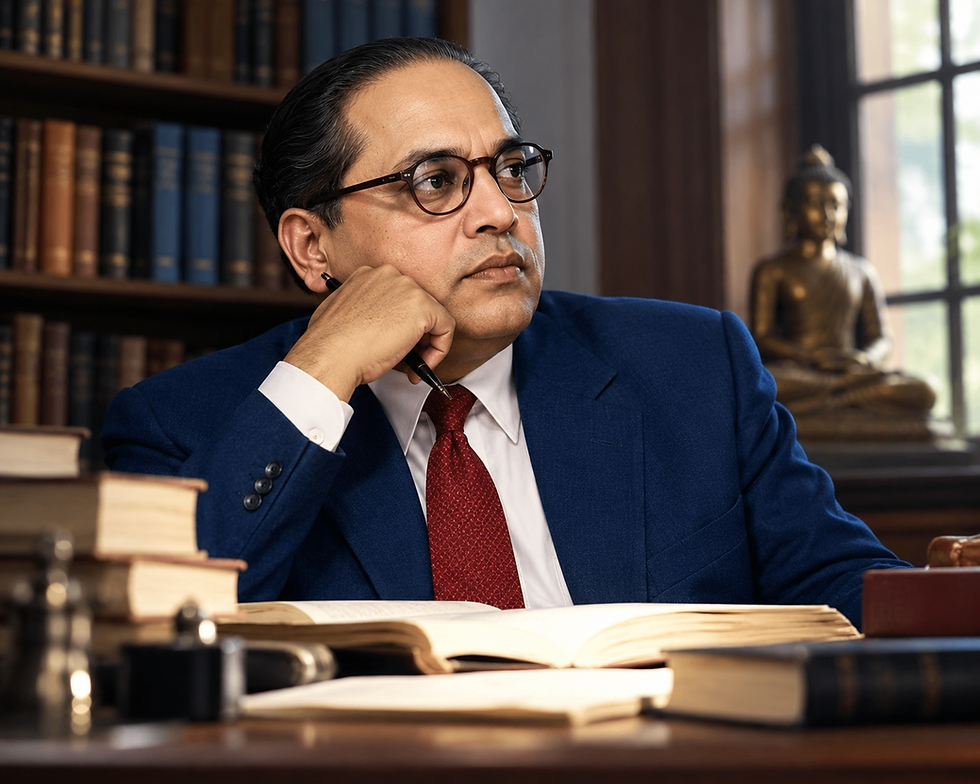
An exploration of reason, human dignity, social justice, democracy and the moral foundations of a free society
Introduction: Beyond the Making of a Constitution
Dr. Bhimrao Ramji Ambedkar occupies a distinctive place in modern Indian intellectual history. He was a jurist, economist, social reformer, political thinker and philosopher whose ideas extended far beyond the drafting of the Indian Constitution. His life's work was driven by a fundamental question: How can human beings build a society in which every individual enjoys dignity, freedom and equal opportunities, irrespective of birth?
Ambedkar confronted a society in which caste determined much of a person's social position, access to opportunities and treatment by others. He experienced discrimination himself, but he did not limit his response to personal suffering. He examined the institutions, beliefs and social arrangements that made such discrimination possible. He wanted to understand not merely why injustice existed, but how it could be dismantled.
His answer was comprehensive. Education must liberate the mind. Reason must challenge unjustified authority. Democracy must extend beyond elections. Economic arrangements must serve human welfare. Religion must be examined through ethical standards. Law must protect individual rights, while society must cultivate a spirit of fraternity.
At the centre of this intellectual project lies a powerful principle: no individual should be considered inferior or superior simply because of the circumstances of birth.
Ambedkar's philosophy is therefore not merely a philosophy of emancipation for one community. It is a challenge to every social system that places inherited privilege above human dignity.
The dignity of the individual
Every philosophy of justice begins with a question about the value of human beings. What entitles one person to greater respect, freedom or opportunity than another? Ambedkar rejected the idea that birth could provide a legitimate answer. In a caste-based society, identity inherited from one's family could determine social expectations, occupations, relationships and access to public life. Such a system did more than distribute privileges unequally. It assigned individuals a social position before they had an opportunity to develop their abilities or make their own choices.
Ambedkar opposed this denial of individual freedom. He believed human beings should be valued for their humanity rather than classified according to inherited status. This principle has implications far beyond caste. Whenever society judges people by ancestry, gender, wealth, religion, race or other inherited circumstances, the question Ambedkar raises becomes relevant: Is this distinction justified by reason and justice, or is it simply an arrangement through which privilege reproduces itself?
His philosophy invites us to judge social institutions by their consequences for actual human beings. A tradition does not become morally acceptable merely because it is ancient. A social arrangement does not become just merely because it is widely accepted.
Human dignity must be the standard by which society is judged, not the reward that society grants to those it considers worthy.
Annihilation of caste: Challenging the foundations of inequality
Ambedkar's Annihilation of Caste, published in 1936, remains one of his most forceful contributions to social philosophy. He argued that caste was not simply a division of labour. It was a division of people into ranked social groups, with inherited boundaries and unequal status. It restricted association, encouraged social separation and obstructed the development of a common sense of humanity.
He also identified a difficulty that remains relevant to social reform: individual kindness cannot, by itself, abolish structural inequality. A person may treat members of other castes politely while continuing to accept a social system that denies them equal status. A community may condemn untouchability while defending other forms of inherited hierarchy. Such reforms may improve individual experiences without eliminating the principles that reproduce discrimination.
For Ambedkar, genuine change required questioning the authority of the ideas and institutions that sustained caste. This was a radical argument because he did not merely request better treatment within the existing hierarchy. He demanded the destruction of the hierarchy itself.
His ideal was a society in which individuals could associate freely, choose their occupations, establish relationships across inherited boundaries and participate in common public life without being constrained by caste. The philosophical significance of this argument is universal. Injustice cannot always be eliminated by improving the behaviour of individuals while leaving unjust institutions untouched. Sometimes the structure itself must change.
Reason and the freedom to question
Ambedkar believed that intellectual freedom was essential to human emancipation. A person who cannot question inherited beliefs remains vulnerable to the authority of those who claim the right to think on their behalf.
Education, in his view, should therefore cultivate independent judgement rather than passive acceptance. This distinction is important. Education is not simply the acquisition of information, certificates or professional qualifications. It should equip individuals to examine evidence, distinguish argument from assertion and question ideas that lack adequate justification.
Ambedkar's criticism of caste was closely connected to this commitment. He challenged religious and social authorities when their doctrines were used to justify inherited inequality. He maintained that no authority should be exempt from moral and intellectual scrutiny merely because it has been accepted for generations.
His approach encourages us to ask difficult questions of our own beliefs.
Why do we believe what we believe? Is our conviction supported by evidence? Does it withstand rational criticism? Are we defending a principle because it is just, or because it protects our social identity and position?
These questions apply to religious beliefs, political ideologies, cultural traditions and even fashionable secular opinions.
Reason does not mean rejecting every inherited idea simply because it is inherited. Nor does critical thinking mean assuming that whatever is traditional must be false. It means refusing to treat age, popularity or authority as substitutes for evidence and justification.
A genuinely educated person should be able to revise a belief when confronted with better arguments.
Liberty, equality and fraternity: The foundation of democracy
Ambedkar's democratic philosophy rests on three closely connected principles: liberty, equality and fraternity.
He did not regard them as separate political slogans. He understood them as mutually supporting conditions for a just society.
Liberty gives individuals room to think, speak, associate, believe, dissent and develop their abilities. Without liberty, society risks becoming oppressive even when it claims to pursue equality. Equality rejects the idea that some people are naturally entitled to dominate others because of their birth, identity or inherited position. Without equality, liberty may become a privilege enjoyed most fully by those who already possess social and economic power. Fraternity creates the bonds of mutual concern that allow people to live together despite their differences. Without fraternity, liberty and equality may remain merely legal principles, enforced from outside rather than accepted as natural features of social life.
Ambedkar explained the relationship between these values in his address to the Constituent Assembly on 25 November 1949. He warned that political democracy could not remain secure unless it rested on social democracy. This is one of the most significant insights of his philosophy.
A country may hold regular elections while its citizens continue to experience humiliation and exclusion in their daily lives. Its Constitution may proclaim equality while social practices reproduce inherited privilege. Its institutions may recognise individual rights while economic dependence prevents many people from exercising those rights meaningfully.
Political democracy is therefore necessary, but it is not sufficient. Democracy must enter schools, workplaces, communities and families. It must influence how people treat one another, resolve disagreements and share opportunities. It must become a way of living together rather than a procedure for selecting governments.
Constitutional morality and the dangers of political hero-worship
Ambedkar placed great importance on constitutional government, legal safeguards and institutional restraint. He understood that the concentration of power creates opportunities for domination, regardless of the identity or intentions of those who exercise it.
A democracy cannot safely depend on the assumption that its leaders will always be wise, benevolent or honest. Institutions must be designed to limit arbitrary authority and protect citizens against abuses of power.
This is why constitutional rights and procedures matter. They establish boundaries that public officials must respect, protect minorities against the tyranny of a majority and provide lawful means of challenging injustice.
Ambedkar also warned against excessive hero-worship in politics. Citizens who surrender their independent judgement to charismatic leaders weaken their own democratic agency. Political loyalty can become dangerous when it is treated as more important than truth, accountability or constitutional principles.
His criticism remains relevant wherever leaders are placed above scrutiny, dissent is treated as disloyalty and institutions are expected to serve personalities rather than the public. Constitutional morality requires more than the formal existence of laws. It requires respect for institutional limits, fair procedures, individual rights and the principle that political authority is never beyond scrutiny.
Ambedkar's contribution to India's constitutional development must be understood in this broader setting. He chaired the Constitution's Drafting Committee and played a central role in shaping its provisions, but the Constitution itself emerged from the collective work of the Constituent Assembly.
His lasting contribution was not simply to help establish institutions. It was to articulate why a democracy needs institutions strong enough to protect citizens, including those who lack social power.
Social and economic justice
Ambedkar's philosophy cannot be understood entirely through caste and constitutional law. His work also addressed economics, labour, public finance, agriculture and the distribution of economic power. He recognised that formal freedom could be undermined by material dependence. A person who possesses legal rights but lacks access to education, employment, adequate resources or economic security may find it difficult to exercise those rights in practice.
This does not mean that every social problem can be solved through government intervention. It means that economic institutions should be judged by how they affect people's freedom, security and opportunities.
Ambedkar's writings explored the relationship between economic arrangements and social justice. His proposals in States and Minorities, for example, assigned the state a substantial role in protecting economic security and organising key parts of the economy.
His work also examined currency stability, public finance, agriculture and labour conditions. These subjects may seem distant from his critique of caste, but they arise from the same fundamental concern: how do social and economic arrangements distribute power, opportunity and vulnerability?
His approach challenges the assumption that economic inequality is always an adequate reflection of individual effort. People begin life under different circumstances, and inherited advantages or disadvantages can influence what opportunities become available to them.
A just society must therefore consider both individual responsibility and the structures that shape individual choices.
Economic growth is important, but it cannot be the sole measure of social progress. We must also ask who benefits from that growth, who bears its costs and whether people possess meaningful opportunities to improve their lives.
Women and the struggle for equality
Ambedkar's commitment to equality extended beyond caste discrimination. He also supported reforms intended to improve women's legal and social position. His efforts to reform Hindu personal law included proposals concerning marriage, divorce, inheritance and property rights. Resistance to the Hindu Code Bill became one of the major issues surrounding his resignation as India's Law Minister in 1951.
The underlying principle was that equality cannot be limited to public declarations while women remain disadvantaged within family and social institutions. The family is a place where values are learned and reproduced. If relationships within the family are organised around domination and unequal rights, broader democratic values may struggle to take root.
Ambedkar's approach therefore invites us to examine gender equality not only through laws and public employment, but also through education, property, economic independence, personal autonomy and social expectations.
A society cannot claim that individual dignity is universal while denying women equal agency in their own lives.
His broader lesson is that social reform must reach every institution in which power shapes human relationships.
Religion, God and the moral purpose of life
Ambedkar's philosophy of religion requires careful understanding. He was a severe critic of religious doctrines that, in his view, legitimised caste and inherited inequality. Yet he did not conclude that every form of religion was necessarily harmful or that morality required belief in a creator God.
His mature religious outlook was non-theistic and centred on ethical conduct, wisdom and the transformation of society. In his 1956 address, Why I Like Buddhism, Ambedkar highlighted three principles: Prajna, meaning wisdom or understanding; Karuna, meaning compassion; and Samata, meaning equality. He valued Buddhism because he believed these principles could help human beings build a better life in this world without making moral progress dependent on belief in God or the soul.
In the same address, he stated: "Neither God nor Soul can save society." The significance of this statement lies in its emphasis on human responsibility. Appeals to supernatural intervention cannot substitute for confronting injustice, and religious identity cannot automatically make a person moral.
Ambedkar's mature philosophy sought a moral framework capable of addressing suffering and inequality through human understanding and ethical action. His adoption of Buddhism in October 1956 was therefore not merely a personal religious event. It was connected to his larger effort to create a social philosophy opposed to caste hierarchy and grounded in dignity, compassion and equality.
His approach presents a useful distinction between religion as unquestionable authority and religion as an ethical tradition. The former may discourage critical examination; the latter can be assessed by its contribution to human welfare.
Ambedkar did not ask us to judge religion merely by its claims about supernatural realities. He also asked us to examine what it does to human beings and the society they inhabit.
Ambedkar and Karl Marx: Justice without sacrificing freedom
Ambedkar recognised the importance of Marx's critique of exploitation and economic inequality. Nevertheless, he disagreed with revolutionary approaches that sacrifice individual liberty or justify coercion in pursuit of a future egalitarian society.
In The Buddha or Karl Marx, he considered whether Buddhism could offer a path towards social and economic justice without the violence associated with certain revolutionary methods. His position was that structural injustice must be confronted, but the methods of transformation matter as well.
A society cannot achieve genuine human liberation by creating a new system of domination in the name of equality. Nor can it expect individual kindness alone to overcome deeply entrenched economic and social inequalities.
Ambedkar's approach attempted to combine structural reform with ethical transformation. Institutions must become more just, but people must also develop the habits of thought and conduct that sustain a just society.
This is an important distinction. Economic equality without liberty risks authoritarianism; liberty without attention to material inequality risks preserving existing privilege.
Ambedkar sought a model in which justice, freedom and moral responsibility could reinforce one another.
The limits and challenges of his philosophy
Respecting Ambedkar does not require treating every claim he made as beyond criticism. A serious engagement with any philosopher must distinguish enduring principles from historical interpretations and proposals that remain open to debate.
Some of Ambedkar's reconstructions of ancient Indian society and the origins of caste remain subjects of historical and scholarly discussion. His critique of religious traditions has also been disputed by thinkers who defend alternative interpretations. His economic proposals raise questions about implementation, institutional capacity and the appropriate balance between public responsibility and individual initiative.
These questions should be examined through evidence and argument. However, disagreement with particular conclusions does not eliminate the importance of the questions he raised. Can inherited status justify unequal rights? Can a democracy remain healthy when social humiliation is widespread? Can formal equality be meaningful without access to opportunities? Can a religion or ideology be morally acceptable if it legitimises domination?
Ambedkar's work demands that we examine such questions without substituting admiration, hostility or identity for reasoned analysis.
The best way to honour a thinker is not to make him immune to criticism. It is to take his arguments seriously enough to examine them.
The contemporary relevance of Ambedkar
Ambedkar's ideas remain relevant because the tensions he identified have not disappeared from human society. Caste discrimination, unequal opportunities, gender inequality, economic dependence, political hero-worship and the conflict between individual freedom and collective authority continue to raise questions about justice. His philosophy also offers a broader framework for examining contemporary problems.
When educational opportunities are distributed unequally, we can ask whether society enables every child to develop their abilities. When social identity determines how individuals are treated, we can ask whether inherited categories have been placed above individual dignity. When economic growth coexists with insecurity and exclusion, we can ask whether prosperity is translating into meaningful freedom.
When political leaders demand unquestioning loyalty, we can ask whether citizens are exercising democratic judgement or surrendering it. When religious or ideological authorities discourage questions, we can ask whether conviction is being protected at the expense of reason.
These questions do not belong to any one political party or community. They are questions about how human beings should organise collective life. Ambedkar's philosophy encourages us to judge societies not merely by their declarations, achievements or symbols, but by the actual conditions under which people live.
The ultimate test of progress is whether individuals can develop their abilities, participate in public life, question authority and live without humiliation or inherited disadvantage.
Conclusion: A philosophy for human emancipation
B. R. Ambedkar's intellectual legacy cannot be reduced to the Constitution, the struggle against untouchability or his embrace of Buddhism. These were different dimensions of a larger philosophical undertaking: the creation of a society in which human dignity becomes the organising principle of social life.
He challenged caste because it subordinated individuals to inherited status. He defended education because independent thought is indispensable to freedom. He advocated constitutional safeguards because power must be restrained. He examined economic structures because formal rights mean little when people lack meaningful opportunities. He embraced Buddhism because he believed wisdom, compassion and equality offered a moral foundation for social reconstruction.
His ideas also reveal that justice cannot be achieved through a single institutional reform or a single change in personal attitude. It requires the combined efforts of education, critical thought, ethical responsibility, constitutional government and the transformation of social relationships.
Perhaps the deepest lesson of Ambedkar's philosophy is that a society must be judged by the humanity it permits its members to express.
A society may be technologically advanced, economically prosperous and politically independent, yet remain unjust if people are humiliated because of their birth or denied the freedom to develop their abilities.
True progress requires something more profound than material advancement. It requires a commitment to the equal dignity of human beings.
Ambedkar's vision invites us to imagine a world in which reason is stronger than prejudice, justice is stronger than inherited privilege, compassion is stronger than indifference and liberty is inseparable from equality. His enduring message is not that society should merely change its opinion of those whom it has historically oppressed. It is that society must remove the structures that make oppression possible.
The measure of a civilisation is not the status it grants to the privileged, but the dignity, freedom and opportunities it secures for every human being.
That is the enduring philosophical challenge of B. R. Ambedkar.
Further Reading
Readers interested in exploring Ambedkar's original arguments may begin with the following works:
Annihilation of Caste (1936) — his critique of caste hierarchy and the ideas used to defend it.
States and Minorities (1947) — his proposals concerning constitutional safeguards and economic security.
The Buddha or Karl Marx — his comparison of two approaches to social transformation.
The Buddha and His Dhamma (published posthumously in 1957) — his interpretation of Buddhism as an ethical and social philosophy.
His address to the Constituent Assembly on 25 November 1949 — his warnings about political democracy, constitutional methods and the relationship between liberty, equality and fraternity.


Comments